
Our Partnerships for the Implementation of Projects
Our Understanding of Partnership
Our involvement is based on mutual understanding between equal-level partners. Our role is to mediate and guide local civil society organisations in order to effectively implement children's rights.
Based on openness, clarity and mutual respect, we support our partners in carrying out their campaigns and projects for the implementation of children’s rights and human
development.
Creating sustainable development is our concern, because whether we live in the global North or South, all of us are responsible for the life chances of future generations. We believe that these can only be enhanced by collaborating in trustful partnerships.
Our Contribution
We offer efficient and effective expert advice, based on our experiences in different African countries:
- Support and guidance on strategy and concept development for a rights-based approach
- Guidance on drafting project proposals
- Involvement in financing projects and support in looking for further means of finance and cooperation partners
- Support in project management (planning, setting up and leading a participatory monitoring system, evaluating etc.)
- Guidance and collaboration on formulating guidelines, procedures or handbooks (“best practices”)
- Guidance in management, including financial management, administration and staff management
- Guidance in increasing public relations and advocacy work for children’s rights
The change towards greater sustainability has to come from local participants who have a vision and a holistic approach to work, and are not restricted to short-term aid.
How partnerships are formed
Strengthening local partner organisations is an important part of KiRA's work. To further expand its commitment to protecting and promoting children's rights, KiRA is currently in the process of establishing new partnerships with promising local organizations. The aim of these collaborations is to develop long-term cooperation and strengthen local capacities in the long term. KiRA has been working closely and continuously with its existing partner organisations for over 10 years.
Our partnerships are based on a multi-step process. First, we check whether the objectives and areas of impact of a potential partner organization are in line with our own approaches and capabilities. The structure is then carefully examined on the basis of various criteria, including available documents from the organization, its web presence, and direct exchange with additional queries. This makes it possible to gain a first impression of motivation and authenticity, management structure and performance, willingness to innovate and learn. This is followed by a personal visit, which serves to deepen the impressions so far collected and also to be able to better assess so-called "soft factors" such as working methods, commitment to children, acceptance by the population, trust and understanding of context. It is particularly important to us that we are not seen as mere financiers, but that our partners are also interested in cooperation in terms of content, that they want to develop professionally and structurally.
If these steps go well, we jointly develop an initial pilot project that Kinderrechte Afrika e. V. closely supports in its implementation in order to test and further develop the cooperation in practice.
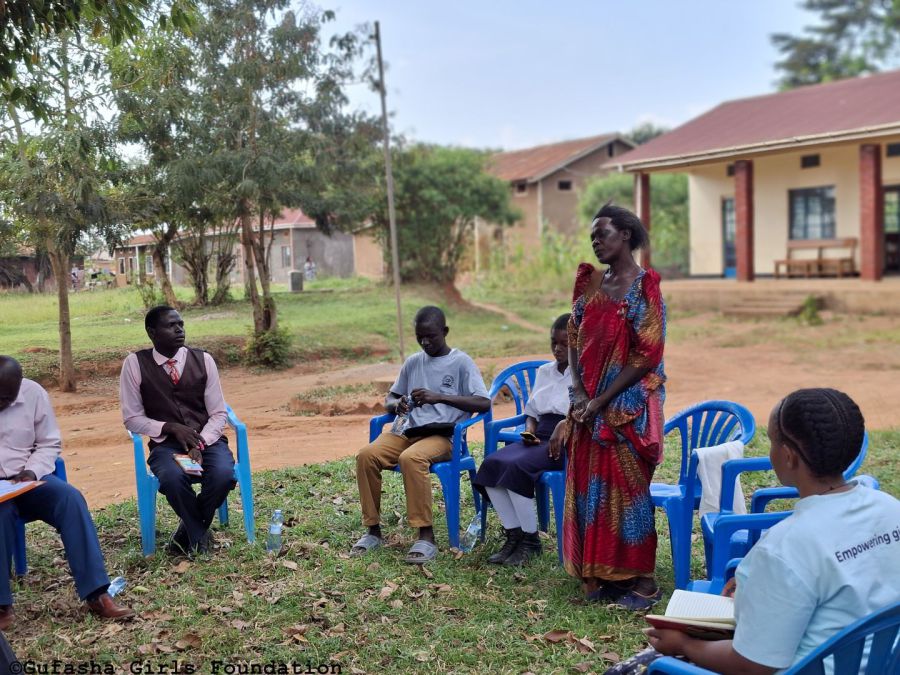
Picture : Meeting with the members of the protection committee of Bbaale © Gufasha Girls Foundation
In this context, we are currently implementing a pilot project in Uganda: Together with the NGO Gufasha Girls Foundation, a twelve-month pilot project entitled "Strengthening Community Systems and Emergency Response for Child and Youth Mental Health in Kayunga District" has been running since May 2026.
- The project aims to establish an integrated, community-based protection system for the mental health of children and adolescents in the community of Bbaale in Kayunga district. This is intended to give children and young people access to psychosocial and psychological support at the local level.
- The target groups of the project include: 100 particularly vulnerable children and adolescents, 40 child protection professionals and actors (police, health services, judiciary and community-based organisations), 30 members of local community committees and 30 caregivers and companions of child protection and meeting rooms at schools.
- The project is financed with 13,000 euros from donations earmarked for this purpose.
In parallel to this pilot project, other partnerships are currently under review:
- In Uganda, the NGO MAWA Africa is further analysed by the AfriChild Centre as part of an organisational assessment in order to identify existing structures, working methods and development potentials as well as to identify possible needs for capacity building. On this basis, a decision will be made as to whether a partnership between KiRA and MAWA Africa is sensible and expedient.
- In Mali and Benin, we are currently in the planning phase of pilot projects with the NGO Kabu-Wolo and the NGO PeACE, respectively.
Our Current Partner Organisations
ALDEPA (Cameroon)
CIPCRE (Cameroun)

ESGB (Benin)
CREUSET (Togo)
PAORP-VWC (Ghana)
GRADEM (Mali)
Marthe Wandou receives Right Livelihood Award 2021
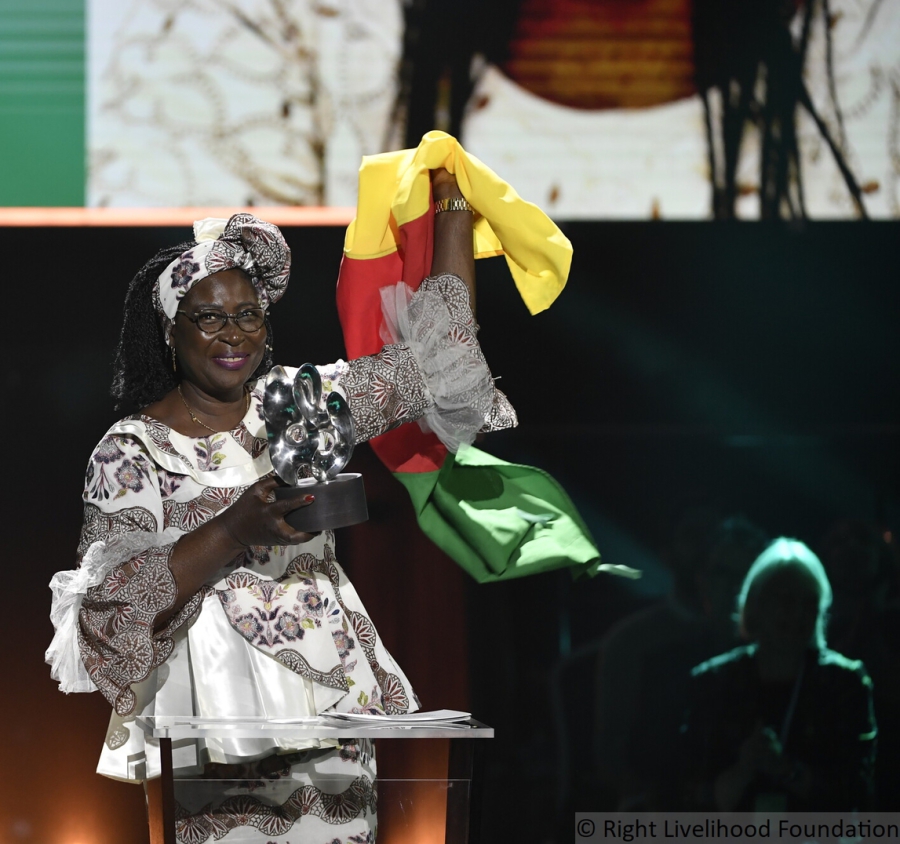
The 2021 Right Livelihood Award, also known as the "Alternative Nobel Prize," went to Marthe Wandou, coordinator of our partner organization ALDEPA in the Far North region of Cameroon.
She received the award “for building a model of community-based child protection in the face of terrorist insurgency and gender-based violence in the Lake Chad region of Cameroon.”
Read more on the Right Livelihood Award Foundation page.
We are proud to have worked with Marthe and her team at ALDEPA on child protection projects for over 10 years!
Félicitations, Marthe!
Other Partners in the Project Regions
In all of our projects, we work with partners on the political and the civil society level, such as
- Ministries for Social Affairs, Human Rights, Interior, Family, Women and Children, Defence, Culture and Health.
- Civil Society Organisations
- Local child protection committees (based on adult and youth volunteers), religious authorities, mayors, village elders and traditional village chiefs.
- Networks of local or international NGOs.
- Media: Journalists, local newspapers and radio stations.
International Partners
Our project would not be possible without the (financial) contribution of our international partners, in particular
- Federal Ministry for Economic Development and Cooperation (BMZ), Germany
- European Union Commission
- Bild hilft e. V. - Ein Herz für Kinder
- Sternstunden e. V.
- Foundation Wilhelm-Oberle
- Foundation Familie-Haas
- Stiftung Entwicklungszusammenarbeit Baden Württemberg (SEZ)
- Globus Foundation
- Freshfields Bruckhaus Deringer LLP
Picture above: Solidarity. © Jacky Naegelen.

Spendenkonto:
Sparkasse Offenburg
Kinderrechte Afrika e.V.
BIC: SOLADES1OFG
IBAN:
DE69 6645 0050 0076 0040 44

Kinderrechte Afrika e. V.
Schillerstraße 16
D-77933 Lahr
Tel.: 07821/38855
Fax: 07821/985755
info[at]kinderrechte-afrika.org
 Druckversion
Sitemap
Druckversion
Sitemap
© 2016-26 Kinderrechte Afrika e. V. - Zukunft für Kinder in Not. Das Kopieren und/oder die Verwendung von Bildern sowie anderen Inhalten dieser Webseite ist nur mit ausdrücklicher Zustimmung von Kinderrechte Afrika e. V. gestattet. La copie et/ou l'utilisation d'images et d'autres contenus de ce site web ne sont autorisées qu'avec le consentement explicite de Kinderrechte Afrika e. V. The copying and/or use of images and other contents of this website is only permitted with the explicit consent of Kinderrechte Afrika e. V.